Cat Enrichment
Why Treat Time Should Be Playtime: A Guide to Enrichment for Indoor Cats
Most cats get their treats in two seconds flat. Here’s why slowing things down, and adding a little game, can make treat time the best part of your cat’s day.
By Ucika · · 8 min read
If you live with a cat, you probably know the routine. You reach for the treat bag, a small furry shape appears from nowhere, and three seconds later the treats are gone. Your cat looks up at you as if to say: that’s it? It’s a sweet moment, but it’s also a missed opportunity.
Treats are one of the few things almost every cat is genuinely excited about. That excitement is energy, focus and curiosity, all pointed in one direction. When we hand treats over in a single gulp, we spend that energy in an instant. When we turn treat time into a small game, we let our cats use it the way nature intended: by thinking, moving, investigating and finally earning the reward.
This guide is about that shift. Not about giving more treats, but about giving them better.
Cats are built to work for their food
Even the laziest-looking sofa cat carries the instincts of a hunter. In the wild, a cat’s day is organised around short cycles of searching, stalking, pouncing and eating. Food rarely shows up in a bowl. It has to be found, figured out and caught.
Indoor life removes most of that challenge. Food arrives on schedule, the environment rarely changes, and there isn’t much to solve. For many cats this is perfectly comfortable, but comfort and stimulation are not the same thing. A cat with nothing to do may sleep more, snack more, or invent its own entertainment, which is often how curtains, plants and 3 a.m. zoomies get involved.
Enrichment is simply the practice of giving those natural behaviours somewhere positive to go. And because treats are already so motivating, they are one of the easiest tools you have.
What “enrichment” actually means
The word sounds technical, but the idea is simple. Enrichment is anything that adds healthy variety and choice to your cat’s day. It usually falls into a few overlapping categories:
- Food enrichment: making mealtimes and treats something to discover rather than simply receive.
- Physical enrichment: climbing, chasing, batting and pouncing.
- Sensory enrichment: new sounds, textures, scents and things to watch.
- Social enrichment: positive time spent with you, on your cat’s terms.
- Cognitive enrichment: small puzzles that reward curiosity and persistence.
The best activities touch several of these at once. A treat game, for example, can involve a little movement, a little problem solving, a new sound and some shared attention from you, all in a couple of minutes.
Why slowing down treat time helps
When a cat has to do something to get a treat, a few good things tend to happen. The moment lasts longer, so the excitement is spread out instead of spent in one bite. Your cat stays focused and engaged, which is a pleasant state for a curious animal. And the reward feels earned, which many owners notice makes their cats more confident and more willing to try new things.
There’s also a practical side. Treats add up, and it’s easy to hand out more than intended when each one disappears instantly. When a treat comes at the end of a short game, you naturally give fewer of them while your cat gets more out of each one. As always, treats should be a small part of your cat’s overall diet, and your vet is the best person to advise on what’s right for your cat.
Simple treat games you can try today
You don’t need special equipment to start. Here are some easy ideas using things you already have at home. Try one at a time and watch how your cat responds. Every cat has its own style.
1. The hide-and-seek treat hunt
Let your cat watch you place a treat in an easy spot, like just behind a chair leg. Once they find it, make the next one a little harder: under the edge of a rug, on a low step, inside an open box. Over a few sessions you can hide treats around a whole room. This taps directly into searching and sniffing behaviour, and it’s a great rainy-day activity.
2. The cardboard puzzle
Take an empty toilet roll tube, fold the ends in loosely and drop a treat or two inside. Your cat will bat, roll and nose it until the treat falls out. An egg carton with treats tucked into a few of the cups works in a similar way. Start very easy so your cat gets an early win, then make it slightly more challenging.
3. The treat toss
Gently roll or toss a treat across a smooth floor so it skitters away. Many cats love to chase and pounce on it like prey. Alternate directions to get a little movement and exercise in. This one is especially good for younger, energetic cats.
4. Trick training
Cats can learn far more than people expect. Short, positive training sessions, teaching a sit, a high five, or coming when called, are a brilliant form of mental stimulation. Keep sessions to a minute or two, reward immediately, and stop while your cat is still interested.
5. A dedicated treat toy
Interactive treat toys turn the reward into a mechanism your cat learns to operate. Some roll, some wobble, some need a paw in just the right place. The appeal is that the toy does the work of making treat time a game, so you can enjoy watching rather than constantly setting up new puzzles.
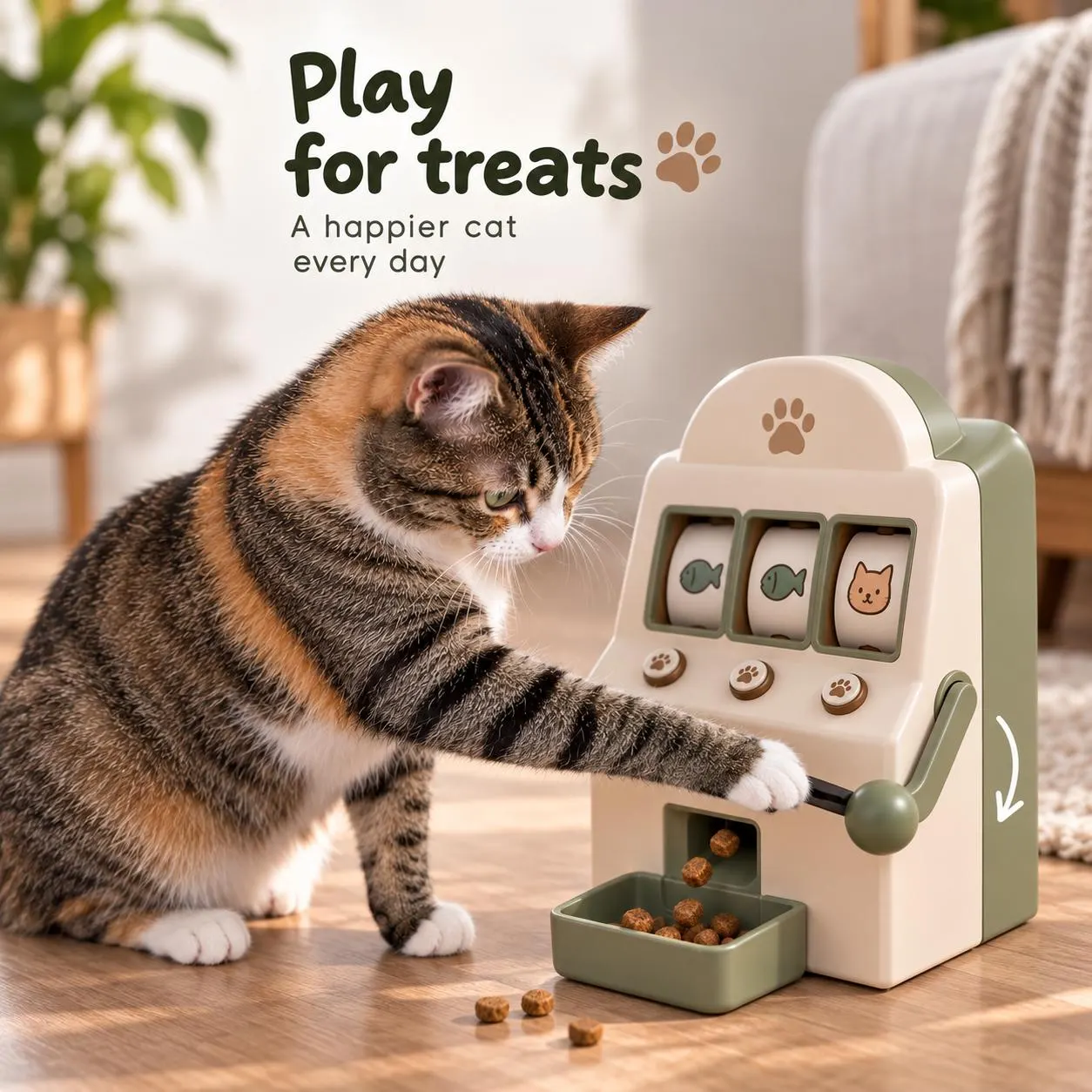
This is exactly the idea behind the Ucika Cat Slot Machine: a small mechanical treat dispenser that turns a single treat into a moment of anticipation, sound and play. It’s designed to be a shared ritual, something you and your cat enjoy together, rather than another toy that ends up under the sofa.
Making it work for your cat
Every cat is different. A confident kitten may tackle a new puzzle in seconds, while a shy senior might need a few days to even approach it. A few principles help every cat succeed:
- Start easy. The first experience should be a quick, guaranteed success.
- Keep it short. A few minutes of focused play is better than a long, frustrating session.
- Follow your cat’s lead. If they walk away, that’s fine. Try again later.
- Rotate activities. Novelty is part of the fun, so swap games every few days.
- Stay nearby. Many cats enjoy games more when you’re part of them.
- Supervise new toys. Make sure anything you introduce is safe and sturdy for your cat.
Signs your cat is enjoying it
Cats communicate a lot through body language. During a good enrichment session you might notice ears pointed forward, a tail held up or gently curved, focused eyes, an excited wiggle before a pounce, or your cat returning to the activity on their own. Some cats chirp, trill or meow at the toy, which is usually a very good sign.
On the other hand, flattened ears, a swishing tail, hiding or walking away repeatedly suggest the game is too hard, too loud or simply not their thing right now. Make it easier, try a different activity, or give it a rest. Enrichment should always feel like fun, never like a test.
Building a daily ritual
One of the nicest things about treat games is that they easily become a ritual. Cats are creatures of habit, and many enjoy knowing that a particular moment of the day belongs to them. It might be a short game when you get home from work, a training session before dinner, or a calm treat puzzle before bed.
These small routines do more than keep your cat busy. They create moments of connection. You’re not just handing over a snack; you’re playing together, paying attention to each other and sharing something you both look forward to. For a lot of people, that becomes one of the best parts of the day, too.
A quick note on indoor cats and boredom
Indoor living keeps cats safe from traffic and many outdoor risks, which is why so many owners choose it. The trade-off is that the indoor world can become predictable. Adding play, climbing spaces, window views and food-based games goes a long way toward keeping indoor cats curious and content.
If you ever notice sudden changes in your cat’s behaviour, appetite or energy, it’s always worth talking to your vet. Enrichment is wonderful, but it complements good veterinary care rather than replacing it.
The takeaway
Treat time doesn’t have to be over in two seconds. With a little creativity, a hidden treat, a cardboard puzzle, a quick trick, or a toy designed for the job, you can turn it into a moment of play, curiosity and connection. Your cat gets to use the instincts they were born with, and you get to watch them light up.
Start small, keep it fun, and let your cat show you what they love. The best enrichment isn’t about doing more. It’s about turning the moments you already share into something a little more joyful.